
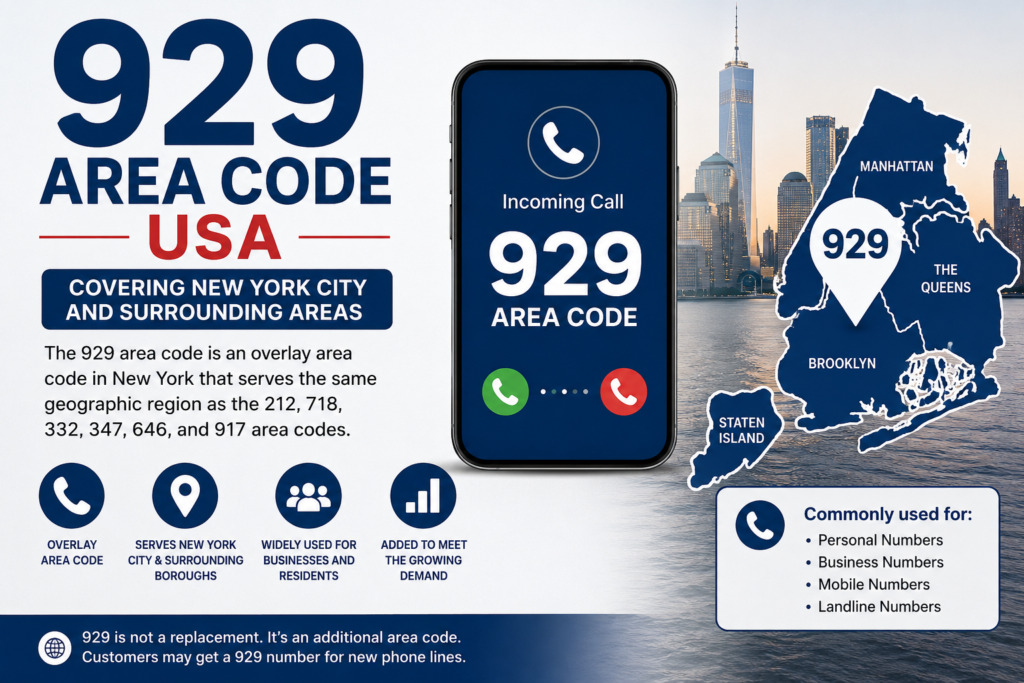

The 929 area code is one of the most recognized telephone area codes serving New York City, covering millions of residents, businesses, and organizations. Whether you recently received a call from a 929 number, are planning to establish a business presence in New York, or simply want to learn more about this area code, understanding its history, coverage, and benefits can help you make informed decisions.
In today’s digital world, area codes are more than just a set of numbers—they represent local identity, business credibility, and geographic location. The 929 area code has become an important part of New York City’s telecommunications network, serving one of the busiest metropolitan regions in the United States.
What Is the 929 Area Code?
The 929 area code is a telephone area code assigned to New York City, specifically covering the boroughs of Brooklyn, Queens, the Bronx, and Staten Island. It operates as an overlay area code, meaning it shares the same geographic region as other existing area codes.
Because of the increasing demand for new telephone numbers driven by population growth, mobile devices, and business communication needs, the 929 area code was introduced to ensure enough phone numbers remained available.
Today, residents and businesses receiving new phone numbers in these boroughs may be assigned a 929 number instead of an older area code.
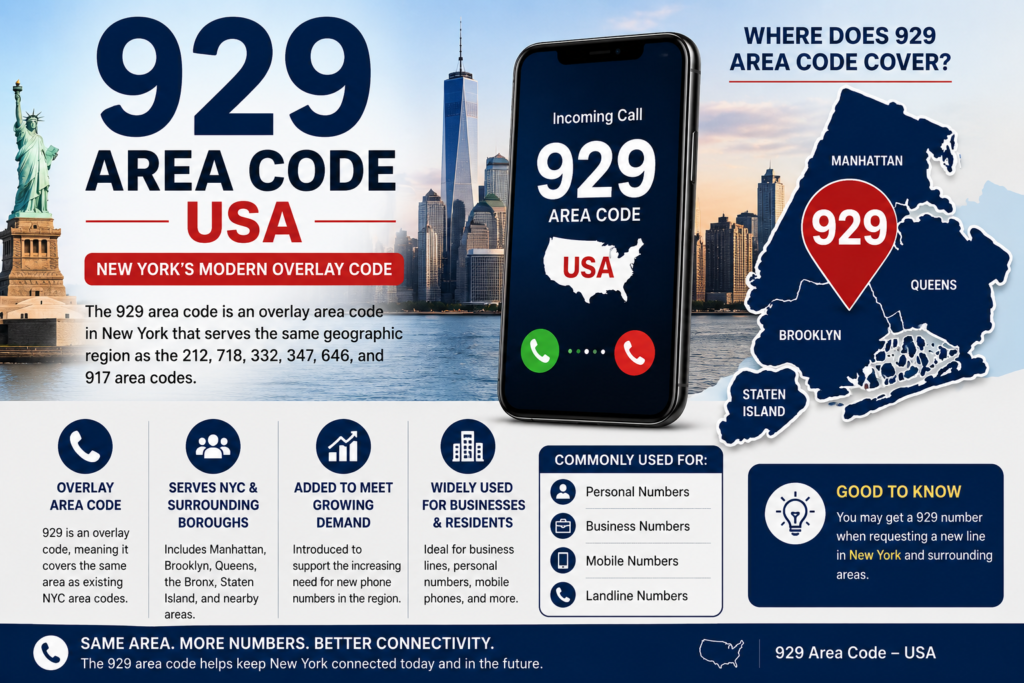
Where Is the 929 Area Code Located?
The 929 area code serves several major boroughs of New York City, including:
- Brooklyn
- Queens
- The Bronx
- Staten Island
These areas are home to millions of people and thousands of businesses across industries such as finance, healthcare, retail, education, technology, transportation, and tourism.
Many neighborhoods within these boroughs now commonly use 929 phone numbers alongside older area codes.
History of the 929 Area Code
Before the introduction of the 929 area code, New York City primarily relied on area codes such as 718, 347, and 917 for the outer boroughs.
As mobile phones, internet-based communication, and business phone systems became increasingly common, the available number supply quickly diminished.
To address this growing demand, the North American Numbering Plan introduced the 929 area code in 2011 as an overlay. Instead of splitting the region geographically, existing numbers remained unchanged while new customers could receive 929 numbers.
This approach minimized disruption for residents and businesses while expanding the available numbering capacity.
Why Was the 929 Area Code Introduced?
The introduction of the 929 area code was necessary due to several factors:
- Rapid population growth
- Increased smartphone usage
- Expansion of businesses
- Growth in VoIP services
- Additional phone numbers required for tablets and connected devices
Without creating a new overlay, the region would have exhausted its available phone numbers.
Cities and Communities Served
Although the 929 area code primarily serves New York City’s boroughs rather than separate cities, it covers countless neighborhoods, including:
- Williamsburg
- Park Slope
- Astoria
- Flushing
- Jamaica
- Long Island City
- Forest Hills
- Bay Ridge
- Coney Island
- Riverdale
- Fordham
- St. George
- Tottenville
Because the coverage area is extensive, millions of residents use 929 numbers every day.
Is the 929 Area Code a Cell Phone Area Code?
One common misconception is that the 929 area code is only used for mobile phones.
In reality, 929 numbers can be assigned to both landlines and mobile phones. They are also commonly used for:
- Business phone systems
- Virtual phone numbers
- VoIP services
- Customer support centers
- Remote work phone systems
The type of phone cannot be determined solely from the area code.
Benefits of Having a 929 Phone Number
Many businesses intentionally choose a 929 phone number because it provides several advantages.
Local Business Presence
Customers often prefer calling businesses with local numbers. A 929 number helps establish trust among New York City residents.
Professional Image
Companies expanding into New York can use a local number without opening a physical office immediately.
Better Customer Recognition
People are generally more likely to answer calls from familiar local area codes.
Easy Business Expansion
Virtual phone systems make it possible to obtain a 929 number regardless of where your business operates.
Time Zone of the 929 Area Code
The 929 area code follows the:
Eastern Time Zone (ET)
This includes:
- Eastern Standard Time (EST)
- Eastern Daylight Time (EDT)
Businesses contacting customers in this area should consider local business hours before placing calls.
Can You Keep Your 929 Number?
Yes.
Thanks to number portability, most users can keep their existing 929 phone number when switching between eligible mobile carriers or service providers.
This convenience allows businesses and individuals to maintain consistent contact information.
Are 929 Calls Safe?
Most calls from the 929 area code are completely legitimate.
However, as with any area code, scammers sometimes spoof local numbers to increase the likelihood that recipients will answer.
If you receive an unexpected call:
- Avoid sharing personal information.
- Verify the caller’s identity.
- Let unknown calls go to voicemail if necessary.
- Block repeated spam numbers.
Using common sense and caution can help protect against fraudulent calls.
Who Should Get a 929 Phone Number?
A 929 number can be an excellent choice for:
- Small businesses
- Startups
- Freelancers
- Customer service teams
- Real estate agents
- Healthcare providers
- Law firms
- E-commerce companies
- Marketing agencies
- Remote workers serving New York customers
A local number often creates stronger trust with customers throughout New York City.
Future of the 929 Area Code
As New York continues to grow, demand for telephone numbers will remain high. Overlay area codes like 929 help ensure enough numbering resources are available for future generations.
Advancements in cloud communications, VoIP technology, and remote work will likely increase the demand for local phone numbers even further.
The 929 area code is expected to remain an important part of New York City’s telecommunications infrastructure for many years.
Conclusion
The 929 area code plays a vital role in connecting residents, businesses, and organizations across Brooklyn, Queens, the Bronx, and Staten Island. Introduced to meet the growing demand for phone numbers, it has become a familiar and trusted area code throughout New York City.
Whether you’re starting a business, relocating, or simply researching a phone number, understanding the 929 area code helps you recognize its importance within one of America’s largest and most dynamic metropolitan areas. With continued population growth and expanding communication technologies, the 929 area code will remain an essential part of New York’s telecommunications network.
Frequently Asked Questions (FAQs)
1. Where is the 929 area code located?
The 929 area code serves New York City, including Brooklyn, Queens, the Bronx, and Staten Island.
2. Is the 929 area code only for cell phones?
No. It is used for both mobile phones and landlines, as well as VoIP and business phone systems.
3. What time zone does the 929 area code follow?
The 929 area code operates in the Eastern Time Zone (ET), observing both EST and EDT.
4. When was the 929 area code introduced?
The 929 area code was introduced in 2011 as an overlay to provide additional phone numbers for New York City.
5. Can businesses outside New York get a 929 number?
Yes. Many VoIP and virtual phone providers allow businesses located outside New York to obtain a 929 phone number.
6. Can I keep my 929 number if I change carriers?
In most cases, yes. Number portability allows eligible users to keep their existing phone number when switching providers.
7. Are calls from the 929 area code trustworthy?
Most are legitimate, but scammers can spoof local numbers. Always verify unexpected callers before sharing sensitive information.
8. Why are there multiple area codes in New York City?
Multiple overlay area codes exist because of the city’s large population and the increasing demand for telephone numbers.
For more, Visit The Future Content