
Artificial Intelligence (AI) has transformed from an emerging technology into one of the most influential industries in the world. Businesses of every size are investing in AI-powered solutions to improve efficiency, automate workflows, and deliver better customer experiences. As a result, the demand for AI professionals continues to grow rapidly across industries such as healthcare, finance, education, manufacturing, marketing, and software development.
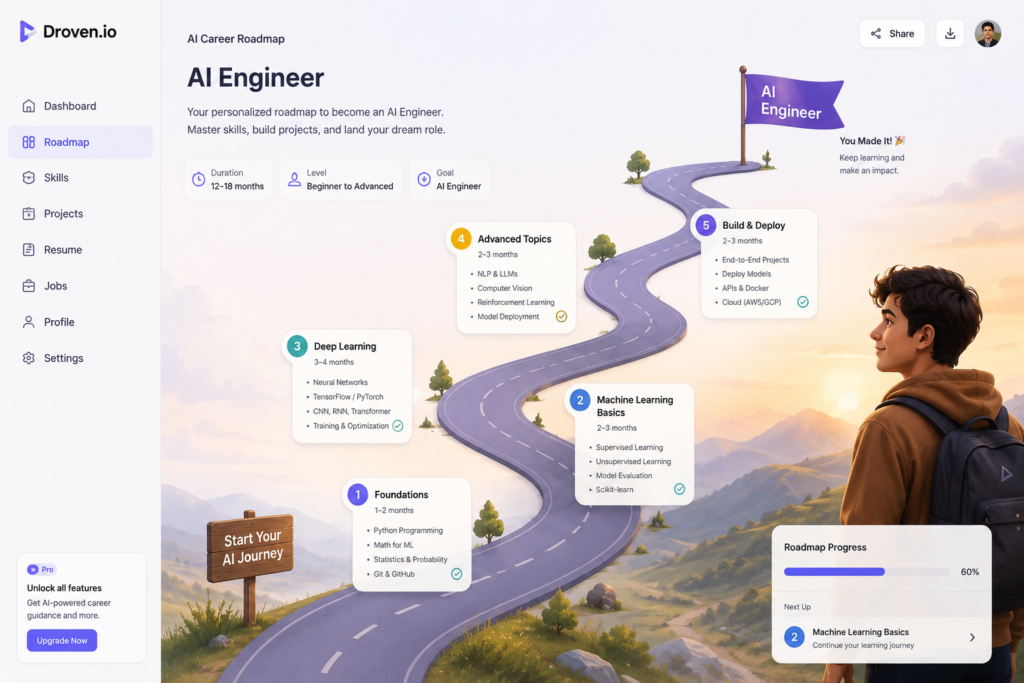
For beginners and professionals looking to transition into AI, finding the right learning path can be overwhelming. There are countless programming languages, frameworks, online courses, and career options available. This is where the Droven.io AI Career Roadmap becomes a valuable resource. It provides a structured learning journey that helps aspiring AI professionals understand what skills to learn, which tools to master, and how to prepare for real-world opportunities.
Why an AI Career Roadmap Matters
Many people start learning AI without a clear direction. They jump from one tutorial to another, watch dozens of videos, and complete random courses without developing practical skills. A career roadmap solves this problem by organizing the learning process into logical steps.
Instead of guessing what to study next, learners can focus on mastering one skill at a time. This structured approach saves time, reduces confusion, and increases the chances of building a successful career.
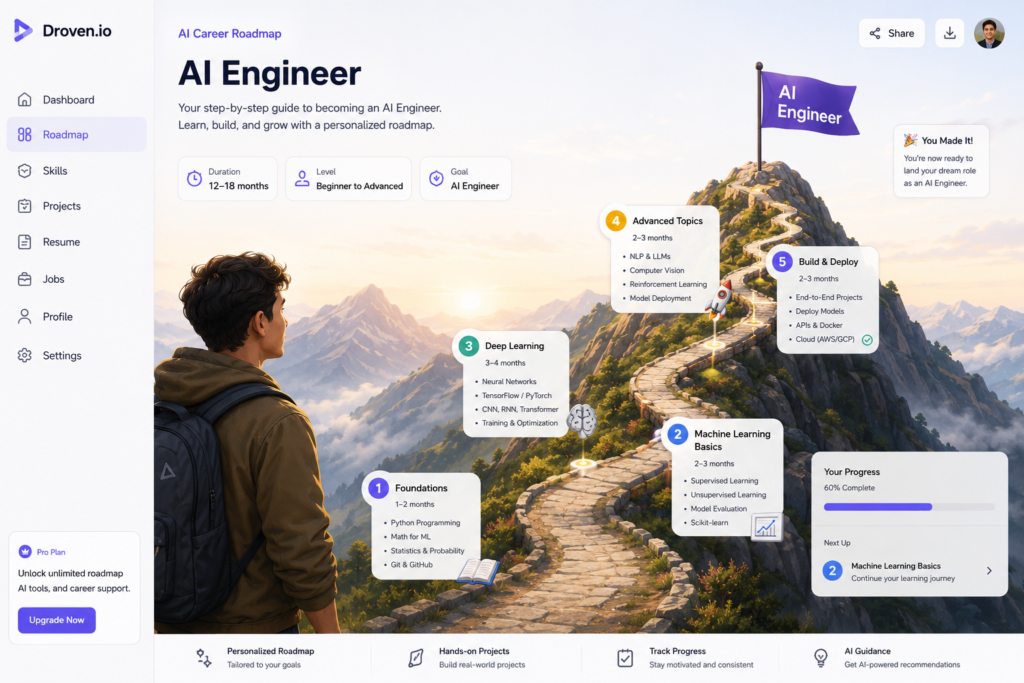
The Droven.io AI Career Roadmap is designed to simplify this process by offering guidance from beginner-level concepts to advanced AI technologies.
Build a Strong Foundation
Every AI professional starts with the basics. Before exploring machine learning or deep learning, it is essential to understand core programming concepts.
The roadmap encourages learners to develop a solid foundation in programming languages like Python, which remains the most widely used language for AI development. Understanding variables, loops, functions, object-oriented programming, and data structures provides the knowledge needed to build more advanced applications.
Mathematics also plays an important role. Topics such as linear algebra, probability, statistics, and calculus help explain how AI algorithms work behind the scenes.
Although mathematics may seem challenging at first, learning the fundamentals makes it easier to understand machine learning models and data analysis techniques.
Learn Data Analysis and Visualization
Artificial Intelligence depends heavily on data. Before building intelligent models, professionals must know how to collect, clean, organize, and analyze information.
The roadmap introduces learners to popular Python libraries such as Pandas, NumPy, and Matplotlib for handling datasets and creating visual reports.
These tools help identify trends, detect patterns, and prepare data for machine learning models.
Data visualization also improves decision-making by converting complex information into charts and graphs that are easy to understand.
Explore Machine Learning
Machine learning is one of the most exciting areas of AI. It allows computers to learn from data without being explicitly programmed for every task.
The roadmap introduces supervised learning, unsupervised learning, and reinforcement learning while explaining common algorithms including:
- Linear Regression
- Logistic Regression
- Decision Trees
- Random Forest
- Support Vector Machines
- K-Means Clustering
Learners also discover how to train models, evaluate performance, and improve prediction accuracy using real-world datasets.
Hands-on projects help transform theoretical knowledge into practical experience.
Dive into Deep Learning
Once machine learning concepts are understood, learners can explore deep learning.
Deep learning uses artificial neural networks to solve complex problems such as:
- Image Recognition
- Speech Recognition
- Natural Language Processing
- Recommendation Systems
- Autonomous Vehicles
The roadmap recommends learning popular frameworks like TensorFlow and PyTorch to build modern AI applications.
Understanding neural networks, convolutional neural networks (CNNs), recurrent neural networks (RNNs), and transformer models prepares learners for advanced AI development.
Discover Generative AI
Generative AI has become one of the fastest-growing fields in technology.
Businesses now use AI models to generate text, images, videos, music, and computer code.
The Droven.io AI Career Roadmap introduces learners to modern AI concepts including prompt engineering, large language models (LLMs), AI assistants, chatbots, and automation tools.
Developing these skills opens opportunities in content creation, customer support, software engineering, education, marketing, and business automation.
As organizations increasingly adopt generative AI solutions, professionals with these capabilities are becoming highly valuable.
Build Real Projects
Learning theory alone is not enough.
Employers prefer candidates who can demonstrate practical experience through real projects.
The roadmap encourages learners to build applications such as:
- AI chatbots
- Image classification systems
- Sentiment analysis tools
- Recommendation engines
- Data dashboards
- Resume screening applications
- Voice assistants
- Predictive analytics systems
Publishing these projects on GitHub creates a professional portfolio that showcases technical skills to recruiters and hiring managers.
Develop Professional Skills
Technical knowledge is only one part of a successful AI career.
Professionals should also improve communication, teamwork, problem-solving, critical thinking, and project management skills.
Working on collaborative projects, participating in hackathons, contributing to open-source communities, and networking with industry experts can significantly improve career opportunities.
Continuous learning is also essential because AI technologies evolve rapidly.
Prepare for AI Job Opportunities
The AI job market offers a wide variety of career paths, including:
- AI Engineer
- Machine Learning Engineer
- Data Scientist
- Data Analyst
- AI Researcher
- NLP Engineer
- Computer Vision Engineer
- Prompt Engineer
- AI Product Manager
- AI Consultant
Each role requires a different combination of programming, mathematics, business understanding, and communication skills.
The roadmap helps learners understand these career paths and identify the skills needed for each position.
Keep Learning and Growing
Artificial Intelligence continues to evolve with new research, tools, and frameworks appearing every year.
Successful professionals remain curious, read research papers, follow industry news, complete advanced certifications, and practice building innovative solutions.
Joining AI communities, attending webinars, participating in competitions, and sharing knowledge with others can accelerate professional growth.
Consistency is often more important than speed. Spending time every week learning and building projects creates long-term success.
Conclusion
The Droven.io AI Career Roadmap provides a structured and practical path for anyone interested in building a successful career in Artificial Intelligence. Rather than learning random topics, it guides aspiring professionals through programming fundamentals, mathematics, data analysis, machine learning, deep learning, generative AI, portfolio development, and career preparation.
Whether you are a student, software developer, data analyst, or career changer, following a well-organized roadmap can reduce confusion and help you develop in-demand AI skills more efficiently. By combining continuous learning with hands-on experience and real-world projects, you can confidently prepare for the growing opportunities in the AI industry and position yourself for long-term career success.
For more, Visit The Future Content